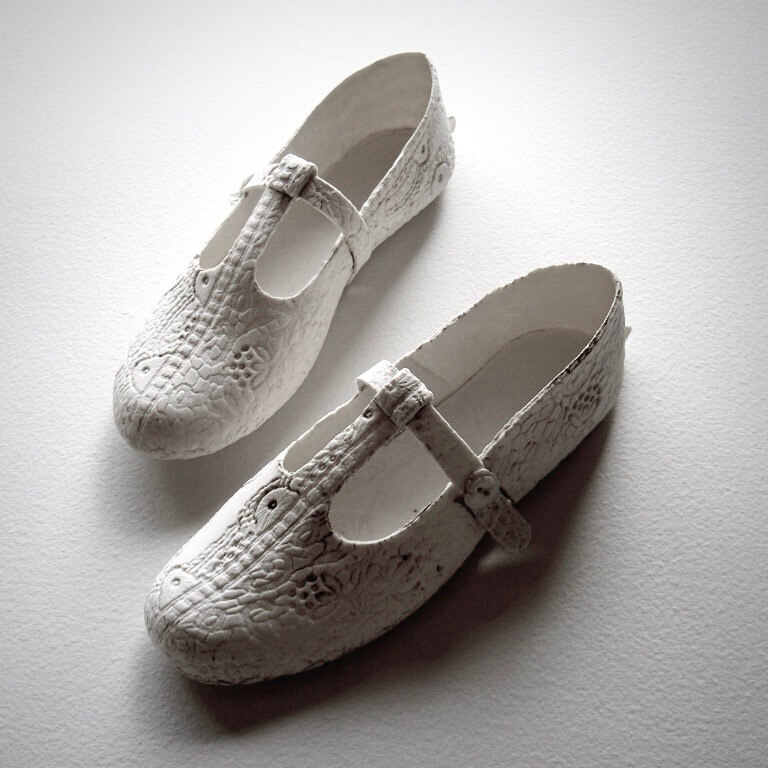
An edited digital image of a pair of my ceramic shoes.
Like many of us during the Covid-19 ‘lockdown’ I have been tidying, sorting and revisiting past work as well as doing a spot of ‘housekeeping’ on my digital files. This has meant sifting through, reviewing and deleting thousands of images that have accrued in recent years.
I have always been interested in photography; the way in which a photograph captures a moment in time from an entirely personal viewpoint providing a unique window on how we see the world.
During my time as a Visual Arts Officer, I regularly received applications to show work, accompanied by a variety of photographs – ranging from extremely professional to quite poor. My colleagues and I used the images submitted to help plan future exhibitions. Wherever possible we tried to visit artists or shows and see the work for ourselves. However this was not always possible due to time, budgetary constraints or geographical distance.
Images are powerful things. Sometimes they can seduce and mislead us. We were caught out on more than one occasion by the camera’s ability to create its own ‘version’ of reality. A little like Henry VIII and Anne of Cleves, we were sometimes disappointed when what arrived ‘in the flesh’ did not live up to the attractive ‘portrait’ sent in advance. It was a valuable lesson and reinforced the knowledge that a photograph is not simply a ‘depiction’ or ‘record’ but a selective and sophisticated ‘interpretation’ of reality. The image is, in fact, often more compelling than the thing it purportedly ‘represents’.
At art college all those years ago I learnt, on a manual Pentax camera, about exposure, focal length, aperture settings and dark room development using trays of chemicals and a variety of light sensitive papers. It was a complex process and required a great deal of equipment and knowledge. Today, with digital cameras, phone cameras, photo editing software and endless photo apps we can all enjoy photography with very little outlay. The creative potential is infinite as I have discovered when capturing and recording my own work. So much so that I often prefer the resulting image to the object I am photographing.
I can lose myself for hours in the “endless visions and revisions” of cropping, adding filters, pushing the structure, definition or warmth settings, adding vignettes or opting for tone or monochrome rather than colour. I enjoy the flexibility, the endless possibilities and permutations that digital photography offers – the power to ‘invent’ and ‘reinvent’ image after image – in the same way I play with the components of my ‘curations’ and paper collages. Nothing is fixed, nothing is irreversible. It can be changed or altered in the blink of an eye.
In this way the freedom and immediacy offered by photography and digital art ‘offsets’ the precise, painstaking and time-consuming processes involved in ceramics – offering light relief. I think this is why I put my bags of clay aside a couple of years ago and placed a virtual ‘ dust sheet’ over my kiln. Creativity is, after all, ‘play’ and I’d lost the ability to be inventive – to have fun. Photography, collage and in particular my ‘curations’ from found objects have allowed me to ‘lighten up’ and start enjoying being an artist again. It’s been interesting to look back and see old work in a new light. So maybe it’s time to ‘uncover’ the kiln and get making – with no expectations and no pressure. Watch this space.